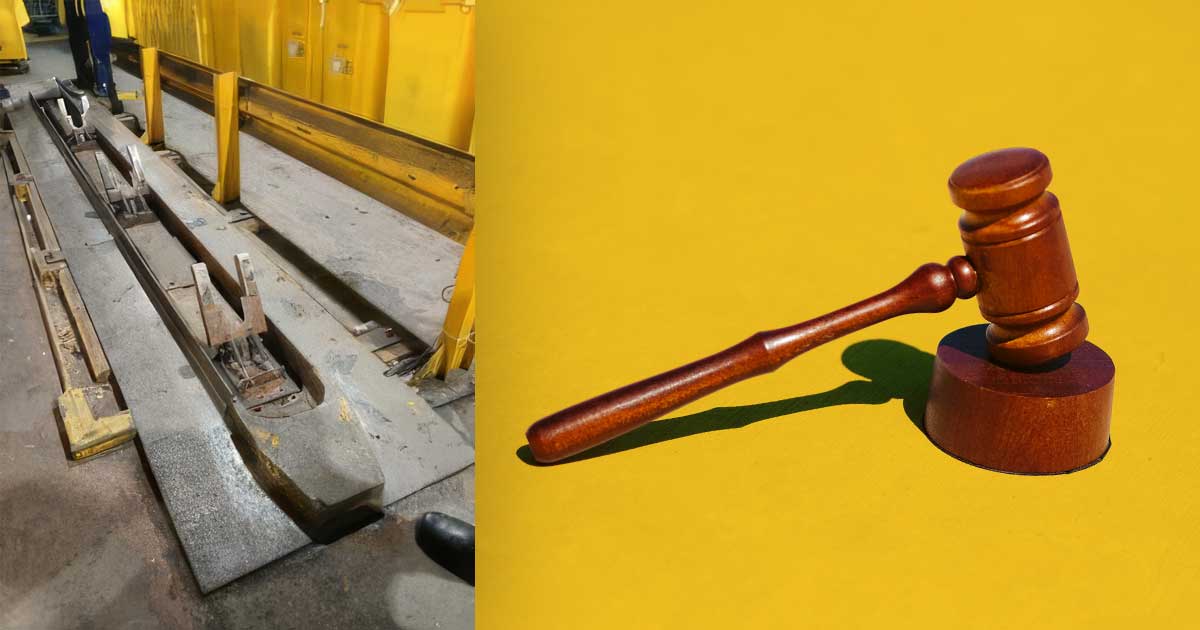
A lack of guarding causes 18-year-old employee’s leg injury
While loading a bin conveyor, a teenage employee’s foot slipped into the unguarded channel. This caused multiple fractures to the worker’s leg, which were of a serious nature.
The incident happened at Stericycle’s clinical waste management operation at Rochdale Road in Oldham, Lancashire, within the grounds of Royal Oldham Hospital. The private company, legally trading as SCRL Ltd, is the UK arm of the international specialist in medical waste management.
Findings from the Health and Safety Executive (HSE)
The HSE has concluded SCRL Ltd did not provide proper protection on the machinery. Their investigation showed the company “had failed to carry out a suitable and sufficient risk assessment and failed to provide suitable guarding on the bin conveyor.”
“A young man at the beginning of his working life was failed by this company,” said HSE inspector Sam Eves.
“This incident could have so easily been avoided by properly assessing the risks and applying the correct control measures to prevent access to dangerous parts of machinery. Companies should know that HSE will not hesitate to take appropriate enforcement action against those that fall below the required standards.”
How this incident could have been avoided
The official guidance from HSE states that employers should take effective measures to prevent access to dangerous parts of machinery or to stop the movement of any dangerous parts before any part of a worker enters a zone of significant risk.
The usual standard is to apply fixed guarding, but where routine access is required, it is reasonable to apply other safeguards to prevent the movement of dangerous parts. Interlocked guards, or presence-sensing protective devices, like safety light curtains or pressure-sensitive mats, are typically used in such situations.
Advice from the experts
Here at Machinery Safety & Compliance Services (MSCS), we assess risks in sites similar to this.
Had we been assigned to inspect this work area, our expertise in following the Provision and Use of Work Equipment Regulations 1998 (PUWER) meant we would have identified this hazard. This underlines the importance of regular PUWER inspections. These allow site managers to make informed decisions on how guarding can be implemented or if it’s worth replacing flagged equipment with a safer solution.
Usually, when faced with a potential danger like the unguarded channel, our first step would be to go through the Hierarchy of Hazard Controls. This starts by questioning whether the potential hazard is necessary for the workplace duties. If it isn’t, then we look for a safer alternative method of transportation.
If there are no safer substitutes that are viable, we consider implementing engineering controls to isolate people from the hazard. Should this not be possible, then we consider changing people’s working methods. If we reach a situation where that is not possible, the final remedy is to deploy Personal Protective Equipment for each worker.
In this case, the unguarded channel is clearly a violation of regulation 11 under PUWER. We’d advise that guarding measures be implemented, which HSE has recommended after the worker’s injury.
We don’t know the full aspects of the incident, but from what we know, our recommended solution would comprise safety light curtains and/or pressure mats to detect when a worker is in a risky area. This would be a mix of fixed guarding with interlock guarding or Electro-Sensitive or Pressure-Sensitive Protective Equipment (ESPE/PSPE).
It would be essential to meet machine safety standards such as BS EN 14120 for physical guarding, BS EN 14119 for interlocking with guards, BS EN 61496 series for light guards and BS EN 13856-1 for pressure-sensitive mats. For assessing the positioning and distancing of safeguards, we would adhere to BS EN 13855 and BS EN 13857.
We believe the equipment was likely incorrect from the point of supply. It appears to be old, although machinery purchasers should always be aware that there are cases where new machinery available on the market will fall short of PUWER compliance. Consequently, we recommend that such machinery should be assessed under PUWER before being put into service.
Financial consequences for the lack of worker protection
SCRL Ltd pleaded guilty to breaching Section 2(1) of Health and Safety at Work etc. Act 1974. They were fined £300,150, plus a victim surcharge of £2,000 and ordered to pay £3,931.85 in costs at Warrington Magistrates’ Court on 16 June 2026.
The prosecution was brought by HSE’s Enforcement Lawyer Gemma Zakrzewski and supported by Paralegal Officer Stephen Grabe.